— Excellence Through Innovation and Quality—
Manufacturing Strength
At XENAMED Industries, our manufacturing strength is driven by precision, innovation, and an uncompromising dedication to quality. We are proud to stand among Pakistan’s foremost manufacturers of specialized medical instruments, trusted worldwide for our consistency and superior craftsmanship.
Offering a comprehensive range of over 7,000 instruments, we serve diverse surgical and medical fields, with every product carefully engineered to comply with international standards of safety and performance.
Through continuous innovation and a strong focus on specialization, we remain at the forefront of the industry — positioning XENAMED Industries not merely as a producer, but as a reliable partner in elevating global healthcare.
Steel
The quality of steel plays a vital role in producing high-performance instruments. The better the material, the better the product. To ensure superior results, we carefully source premium-grade steel, whether imported or locally selected, in accordance with the specific requirements of our valued customers.
Forging
Forging is the process of shaping raw metal into instrument forms using dies and hammers. Through the expertise of skilled craftsmen, the metal is brought to life and given its initial form, which then proceeds through a series of precise and complex manufacturing stages.
Machining
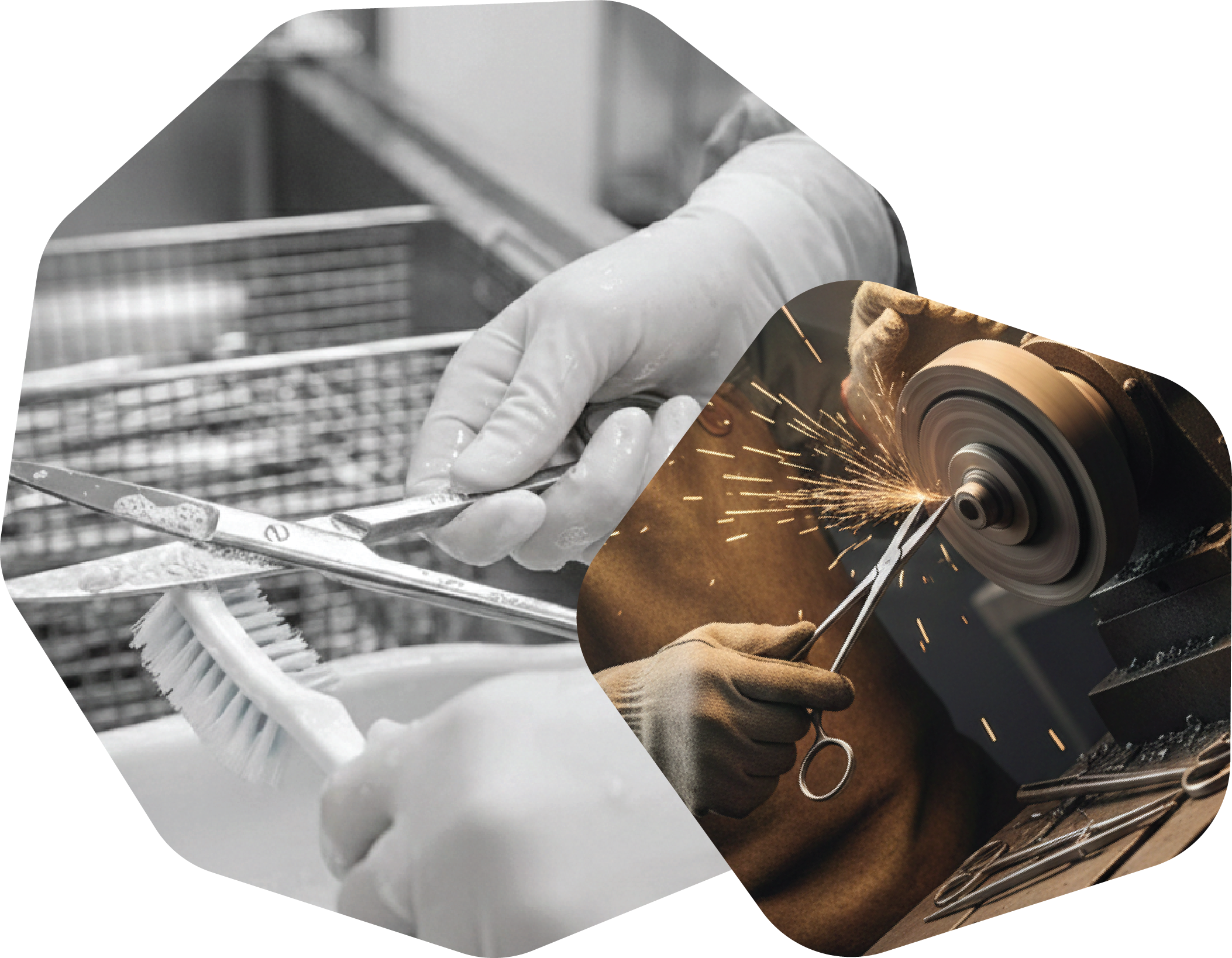
The forged pieces are further cut and shaped by machines to refine sharp edges and define the raw form. Through precise grinding and hammering, the instruments are brought to their final shape. This stage demands exceptional skill and is performed exclusively by experienced instrument specialists.
Milling
Holes are precisely drilled in the instruments wherever screws are required. Various types of screwing machines are used, and matched instrument pairs are assembled at this stage. Even the smallest variation in hole alignment can affect performance, so absolute accuracy is strictly maintained.
Filling & Fitting
At this stage, the steel is still relatively soft, allowing filing to be used to achieve the exact required shape. Skilled workers carefully match each piece to the provided samples, ensuring precise conformity. Most of the instrument’s final form is defined during this process.
Boil Treatment
The technician sterilizes metal, rubber, and plastic items by immersing them in boiling water for 20 minutes. Once the process is complete, the items are carefully removed using sterilized tongs and immediately transferred to a sterile container to maintain hygiene.
Heat Treatment
Surgical instruments operate under demanding environmental conditions and must consistently meet the highest standards of hygiene and quality. Technological advancements have significantly enhanced these capabilities, while the careful selection of materials forms the essential foundation for achieving and maintaining these strict performance requirements.
Hardness Test
After annealing and heat treatment, the instruments are tested with diamond-tipped Rockwell hardness testers to verify that the required hardness levels are achieved. To further ensure accuracy and reliability, Norfolk International’s quality control team also submits samples to independent testing laboratories for result validation.
Acid Pickling
Pickling involves immersing metal in a specially formulated acid solution known as pickle liquor. After fabrication, the metal is submerged in this solution, which removes any oxides or surface impurities, leaving the metal clean and ready for further processing.
Joint Grinding
As a result, medical orthopedic implant grinding has emerged as a promising diversification opportunity for both established and new entrants in the CNC tool cutting industry. Joint reconstructive surgeries—primarily knee, hip, and shoulder procedures—rely heavily on orthopedic implants and related instruments, which typically undergo precise grinding during manufacturing.
Electro Chemical
The present invention relates to an electrochemical surgical knife that integrates both a chemically assisted mechanical dissector and an electric cutting element within a single instrument.
Final Setting
A surgical procedure involves a diverse range of instruments, each designed for specific functions and offering distinct advantages—and sometimes limitations. For a surgeon, it is essential to understand not only the names of these tools but also the appropriate context for their use, with each medical specialty having its own tailored set of instruments.
Surface Grinding
The basic form of the tool is typically machined on Swiss-type lathes while the material is still in a more malleable state. This process includes creating the driving notch—the quick-disconnect feature at the end of the shank. Afterward, the tool undergoes hardening or centerless grinding to achieve its final specifications.
Device Adjustment
The therapeutic applications of electrosurgery are outlined, along with innovative tissue dissection techniques such as ultrasonic and water jet methods. This is followed by a detailed examination of stapling devices and a comprehensive overview of suture materials and surgical meshes.
Beveling
The angled design of a needle tip allows for smooth, atraumatic entry into a vein. This is known as a beveled needle tip.
Electro Chemical 2
After grinding, the instruments undergo electro-polishing—a process in which their surfaces are smoothed anodically in a specific chemical solution. This not only gives the instruments a polished, shiny finish but also removes any remaining burrs.
T.C Welding
Tungsten carbide (TC), a type of carbide within the broader ceramic family, deserves special mention for its role in instrument manufacturing. Composed of tungsten and carbon atoms, it is widely used to produce instruments such as needle holders, scissors, pin cutters, pliers, and wire tighteners.
Alignment
Surgical Instrument Alignment Procedure: Identify the target within the surgical area. Position the tip of the instrument at the intended insertion point. Rotate and adjust the instrument to achieve the correct orientation. Proper alignment is confirmed by matching the coaxial point or parallel projection lines on the instrument, or by aligning straight parallel lines along its cylindrical surface.
Initial Polishing
After electro-polishing, the instruments are transferred to the polishing section, where experienced Norfolk International technicians refine their shape and achieve a smooth, polished finish using specialized polishing equipment.
Sand Blasting
After passivation, the polished instruments are moved to the sandblasting unit, where the joints, teeth, and ratchets are treated to achieve a matte finish and enhance corrosion resistance during use. Sandblasting also effectively removes light or dark surface spots, ensuring a uniform appearance.
Final Polishing
Following alignment and inspection, all instruments undergo final polishing to meet specific requirements, achieving either a mirror, satin, or matte finish.
Final Sand Blasting
This process involves removing sharp edges using specialized machinery, ensuring the instruments are completely smooth and safe, minimizing the risk of failure during use.
Ultrasonic Cleaning
At this stage, the instrument is largely complete and undergoes thorough cleaning in water- or chemical-based ultrasonic machines to remove oils and finishing residues before proceeding to the final inspection.
Copper Sulfate Test
The copper sulfate test is employed to identify metallic iron and iron oxide present on material surfaces.